
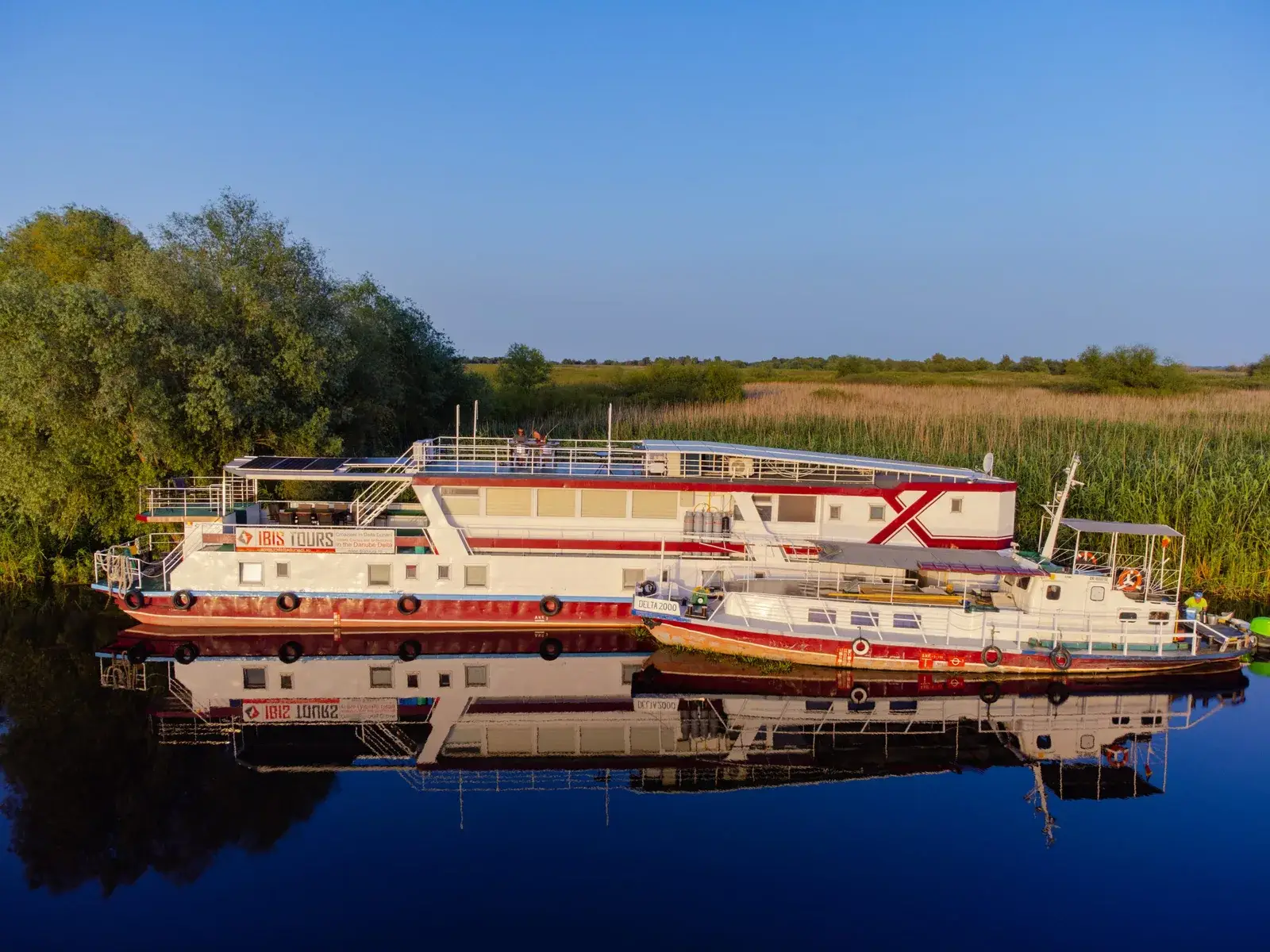
What Is Live-Aboard Birdwatching?
Live-aboard birdwatching means sleeping on a vessel inside the habitat you're there to explore — not in a hotel in the nearest town, commuting each day by boat. In the Danube Delta, the difference is decisive.
The Danube Delta covers 5,800 km². The highest-quality birding areas — the UNESCO strictly protected cores where Dalmatian Pelican colonies nest, where Ferruginous Duck breed on floating islands, where White-tailed Eagles hold territories — are 45 to 90 minutes from the Tulcea waterfront by motorboat. That means any land-based visitor loses their first and last hour of prime birding time every single day, each way, to travel.
A floating hotel eliminates this entirely. You anchor overnight 200 metres from a pelican colony. You have your breakfast as the delta wakes up around you. You are already there before the light changes.

Narrow gârla channels accessible only by small motorboat — the kind anchored directly to the floating hotel overnight.
The Ornithological Case for Live-Aboard
Ask any serious birder what the two best hours of the day are and they'll tell you: the hour after dawn, and the hour before dusk. These are the periods when birds are most active, most vocal, and most visible. They are also precisely the periods a day-trip visitor sacrifices to boat travel.
In the Danube Delta specifically, this matters more than anywhere else in Europe, for several reasons.
Dawn: The Reed Beds Come Alive
Between 04:30 and 07:00 in peak season, the reed beds produce a wall of sound unlike anything in European ornithology. Great Reed Warbler, Savi's Warbler, Marsh Warbler, Aquatic Warbler — all singing simultaneously in the dark before you can see them. Herons leave roost colonies in waves. Bitterns boom from deep reed. Marsh Harriers begin quartering. You need to be inside this to experience it, anchored and silent, not approaching by motorboat from 45 minutes away.
Dusk: The Night Shift Begins
As the sun drops, Night Herons emerge from daytime roost. Little Bitterns become active along channel edges. Ferruginous Ducks — shy and retiring during the day — move onto open water. Owls call from gallery forest. The Spotted Crake, one of the delta's most sought nocturnal species, can be heard reliably from an anchored vessel in a quiet channel. None of this is accessible to a day visitor who must return to Tulcea by 19:00.
The UNESCO Core Zones
The delta's strictly protected core areas — Sireasa, Sontea, Lac Nebunu — require an ARBDD (Danube Delta Biosphere Reserve Authority) permit and a licensed naturalist guide. The permit system prioritises low-impact access. Only vessels with overnight permits are authorised to operate in certain channels during breeding season (April–July). Ibis Tours holds all required permits and all guides are ARBDD-certified.
No day-trip boat from Tulcea can legally enter certain core-zone channels during the breeding season. These are the channels where Dalmatian Pelican colonies nest, where Purple Heron and Spoonbill colonies roost, and where the delta is at its wildest. Overnight permit holders — like the Ibis Tours floating hotel — have unique authorised access.
The Floating Hotel: What's On Board
The Ibis Tours floating hotel is not a houseboat or a camping barge. It is a purpose-built 4-star vessel designed around the needs of wildlife tourists. It has operated continuously since 1995 and has been upgraded several times since.


| Feature | Floating Hotel |
|---|---|
| Cabins | 10 en-suite double/twin cabins |
| Capacity | 9–20 guests per departure |
| Catering | Full board — all meals included from lunch Day 1 |
| Decks | Two open terraces — bow (forward viewing) + stern (tripod photography) |
| Motorboat | Dedicated motorboat for excursions — max 10 guests |
| Guide | Expert naturalist guide, resident on board throughout |
| Permits | All ARBDD permits included |
| Connectivity | Limited — intentional. No TV. You're here for the delta. |
A Day on the Floating Hotel: Hour by Hour
No two days in the delta are identical — water levels, wind direction, and seasonal timing all shift what's accessible and what's active. But this is a representative day in May, the single best month.
Guide knocks gently. Coffee available in the salon. The motorboat is already running quietly alongside. You dress in layers — it is 10°C on the water at this hour.
The motorboat enters the narrow gârle as light breaks. Engine off where possible. Dalmatian Pelicans begin moving between roost and feeding lakes. Marsh Harriers lift from the reeds. The guide whispers identifications as birds pass the bow.
Return to the floating hotel. Breakfast: eggs, local cheese, bread, fruit. The guide reviews the morning's sightings and explains what's ahead. Species list updated. Photography reviewed.
Second excursion — this time to the open lakes. Pelican rafts, White-tailed Eagle surveys, and the floating islands (plauri) where Black Tern nest on lily pads. Bee-eaters calling from sandy banks.
Return for lunch. Romanian fish dishes — carp, pike, catfish — from the delta itself. Time to organise photos, read, or simply sit on deck watching the channel. Kingfishers perch on nearby stakes.
The floating hotel has moved to its next anchorage. A different ecosystem: Letea Forest or the Sulina arm. Roller, Hoopoe, Golden Oriole in the forest edges. The guide explains the delta's geological formation.
The most atmospheric hour. Night Herons emerge. Little Bitterns visible at channel edges. Ferruginous Duck on open water. The sun sets over the reeds in shades of orange and red that photographers live for.
Four-course dinner on board. The guide reviews the day's species list — typically 60–90 species on a May day. Wine optional. Stars overhead. No light pollution. A Barn Owl may call from the darkness.
For those who want it: a short excursion in near-darkness. Nightjar churring, Spotted Crake calling, bats over the water. An experience genuinely impossible from any land base.
Month-by-Month: What to Expect on Board
The floating hotel operates April through October. Each month offers a distinct experience — here is an honest breakdown.
| Month | Rating | Highlights | Conditions |
|---|---|---|---|
| April | Arrival of summer migrants, first herons, warblers beginning to sing. Raptors on northward migration. | Cool (8–16°C on water), occasional rain. Layers essential. Virtually no mosquitoes. | |
| May | Peak season. All species present. Pelican colonies active. Breeding activity. Long days (04:30 dawn, 20:30 dusk). Max diversity. | 15–24°C. Perfect. Light mosquitoes in evenings — DEET or head net advisable. | |
| June | Pelican chicks. Heron colonies with young. Letea Forest at full leaf — Rollers, Golden Orioles, Lesser Spotted Eagles. Bee-eater colonies. | 20–28°C. Warm. Mosquitoes present especially around dawn/dusk — repellent essential. | |
| July | Post-breeding concentrations. Pelican rafts of 500+ birds on open lakes. First southward wader migration. Spoonbills still visible. | 25–33°C. Hot afternoons. Dawn excursions are the best part of the day. Mosquitoes at peak. | |
| August | Water lily bloom spectacular. Early autumn migrants appear. Wader diversity increases. Black Stork in migration. | 22–30°C. Still warm. Mosquitoes declining. Water levels high — some channels inaccessible. | |
| September | Autumn migration in full swing. Raptors, storks, swallows. Reed beds turn gold. Osprey regular. Comfortable temperatures. | 16–24°C. Excellent. No mosquitoes. Best month for photographers — golden reed light. | |
| October | Late migrants. Geese and ducks arriving. Long-distance migration visible overhead. Atmospheric autumn light. | 10–18°C. Cold mornings. Layers needed. No mosquitoes. Some departures limited availability. |
Species Only Accessible from Live-Aboard
The following species are either inaccessible or extremely difficult to observe properly from day-trip boats. From the floating hotel, anchored overnight in the relevant habitat, all are regularly recorded on Ibis Tours cruises.
🌙 Nocturnal & Crepuscular Species
- Spotted Crake Porzana porzana — calls from deep reed after dark. Heard reliably on overnight anchors in quiet channels.
- Little Crake Zapornia parva — similar behaviour. Calls most actively 22:00–02:00.
- Eurasian Bittern Botaurus stellaris — booms from reed well before dawn. Only heard by those already on the water at 04:00.
- Night Heron Nycticorax nycticorax — emerges at dusk, active all night. Best observed from the deck during the dusk excursion.
- Barn Owl Tyto alba — nests in abandoned delta buildings. Calls over water at night.
- Common Nightjar Caprimulgus europaeus — churring from Letea Forest edges after dark.
🚫 Core Zone Species (Permit Required)
- Dalmatian Pelican Pelecanus crispus colony approach — within 200m of nesting islands (with licensed guide, during defined periods).
- Ferruginous Duck Aythya nyroca on plauri — floating islands in core zones, accessible only with ARBDD permit.
- White Pelican roost at Lac Furtuna — dawn access before day visitors arrive.
- Purple Heron colonies in restricted reed zones — visible only with overnight anchorage position.
Photography from the Floating Hotel
For wildlife photographers, the floating hotel offers conditions that cannot be replicated from shore or a day-trip vessel. Here is what to know before you arrive.
The Stern Deck
The lower stern deck is the primary photography platform. It is flat, wide, and has a solid railing suitable for beanbag support. The height above water — approximately 1.5 metres — gives a near-eye-level shooting position for waterbirds, dramatically reducing backgrounds and improving bokeh on distant reed beds.
Motorboat Positions
During motorboat excursions, the guide positions the boat to give the best shooting angle. The engine is cut well before approaching subjects. Most serious photographers photograph from the motorboat rather than from the floating hotel itself — it gets you to within 15–30 metres of nesting pelicans, egrets, and herons.
Lens Recommendations
A 500mm prime or 100–500mm zoom is the standard choice. A 300mm f/4 or f/5.6 works well for colonies and larger subjects. Bring a 70–200mm for wider environmental shots — the delta landscape is as photogenic as the birds. A teleconverter (1.4×) is useful but requires faster shutter speeds on a moving boat.
Best Light Windows
Dawn excursions leave before nautical twilight ends — you're on the water before direct sun hits. This gives 60–90 minutes of soft, diffused light ideal for bird photography. September produces the most spectacular conditions: low sun, golden reeds, mist on the channels. May produces the most subjects — both quantity and diversity at peak.

Motorboat excursions from the floating hotel — the engine cuts before approaching nesting sites.
Floating Hotel vs. Land-Based Hotel: An Honest Comparison
| Factor | Floating Hotel (Ibis Tours) | Tulcea Land Hotel |
|---|---|---|
| Dawn birding | ✓ On the water at 05:00. Already inside habitat. | ✗ 45–90 min boat ride each way. Miss first light. |
| Night birding | ✓ Step off the gangway. Spots Crake, bitterns, owls. | ✗ No public boats after ~18:00. Impossible. |
| UNESCO core zones | ✓ Overnight permit. Authorised access at dawn. | ✗ Day permits only. Certain channels closed. |
| Species per day | ✓ Typical May day: 70–95 species. | Typical day trip: 40–60 species. |
| Comfort | ✓ 4-star en-suite cabins. Full board. Expert guide always available. | Hotels in Tulcea range from 2-star to 3-star. You travel to meals. |
| Photography | ✓ Stern deck tripod-ready. Eye-level from motorboat. | Shooting from commuter boats — rarely positioned optimally. |
| Group size in field | ✓ Max 10 per motorboat. Guide to guest ratio 1:10. | Day-trip boats often carry 20–30 tourists. Not wildlife-focused. |
| Guide knowledge | ✓ Resident naturalist guide for the entire programme. | Day-trip guides vary significantly in ornithological expertise. |
Packing List for the Floating Hotel
The floating hotel provides towels, linens, and full board. Bring the following.
🔭 Optics
- Binoculars — 8×42 or 10×42 recommended
- Spotting scope (optional — guide has one)
- Camera with 400–600mm reach
- Spare batteries (no charging in field)
- Lens cloth — humidity in delta is high
👕 Clothing
- Neutral colours — olive, grey, tan. No white or bright.
- Waterproof jacket — even in summer, dawn on water is cold
- Warm fleece — May/September mornings are 8–12°C
- Hat with brim — sun on open water is intense
- Sun protection — SPF 50 minimum
- Rubber-soled shoes (boat deck can be wet)
🦟 Health & Comfort
- DEET repellent (30%+) — essential June–August
- Head net (lightweight) — for dusk excursions
- Antihistamine — bites inevitable for some
- Sunscreen SPF 50
- Seasickness tablet (precaution — vessel is very stable)
📚 Reference
- Field guide — Mullarney et al. Collins Birds of Europe
- Smartphone with Merlin Bird ID installed (offline Romania pack)
- Notebook — guides provide daily species lists but personal notes enrich the experience
- Binoculars harness — better than neck strap over 6 hours
Frequently Asked Questions
Questions about the floating hotel experience come in a predictable pattern. Here are the most common, answered directly.
Is there mobile signal on board?
Partial. Romanian operators (Vodafone, Orange) have coverage on the main Sulina arm and near larger villages. In the core delta channels, signal disappears — which is, for most guests, a feature rather than a problem. The guide's satellite phone is available for emergencies.
How stable is the vessel?
The floating hotel anchors each night in sheltered channels. The delta has no open-sea swell. The vessel is flat-bottomed and very stable — comparable to a wide canal boat. Motion sickness is rare. The crossing from Tulcea to the delta (first and last day) takes approximately 2 hours on the Sulina arm, which can have low chop in wind, but the vessel handles it well.
Can I join as a solo traveller?
Yes. Single occupancy supplements are available. Solo birders are common — many guests travel alone and the communal meals and excursions make it an unusually sociable experience. It is common to meet other birders with whom you maintain contact for years afterwards.
What is the cancellation policy?
See our Terms and Conditions. We strongly recommend travel insurance covering tour cancellation, as delta conditions occasionally require itinerary adjustments (never whole-trip cancellation).
Experience the Delta from the Water
The floating hotel operates April–October. Maximum 20 guests per departure. 2026 season dates now open.
Species Seen from the Floating Hotel
The live-aboard position in the delta's core zone gives access to species that day-trippers rarely encounter. Field guides for all key species.