
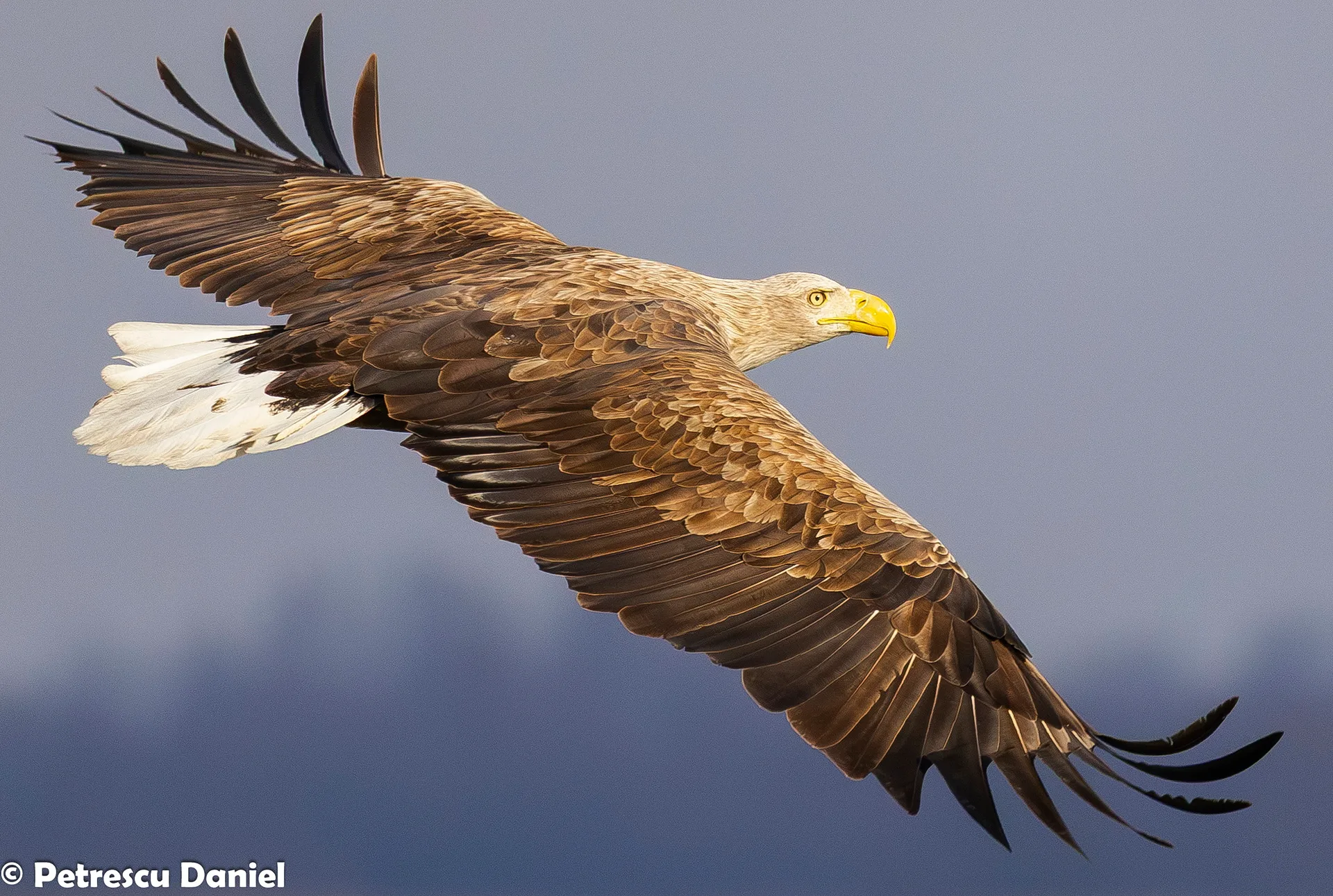
The White-tailed Eagle (Haliaeetus albicilla) is the largest aquatic eagle in Europe and an apex predator of coastal and wetland ecosystems. In the Danube Delta it can be observed throughout the year, with higher chances in winter and during periods of low water when food resources are concentrated. Identification: massive silhouette, broad 'plank-like' wings, pale head; adults have a white tail; juveniles are more uniformly dark brown. Soars extensively using thermals. Ecology: feeds on fish, waterbirds and carrion; prefers areas with mature trees for nesting, close to food-rich waters. Observation: lake margins, wide channels and areas with isolated trees; at sunrise or sunset the light highlights the silhouette and head detail. Conservation: European populations recovering locally, but sensitive to disturbance, felling of mature trees and contaminants; professional guiding supports observation from a distance without impact.
Identification
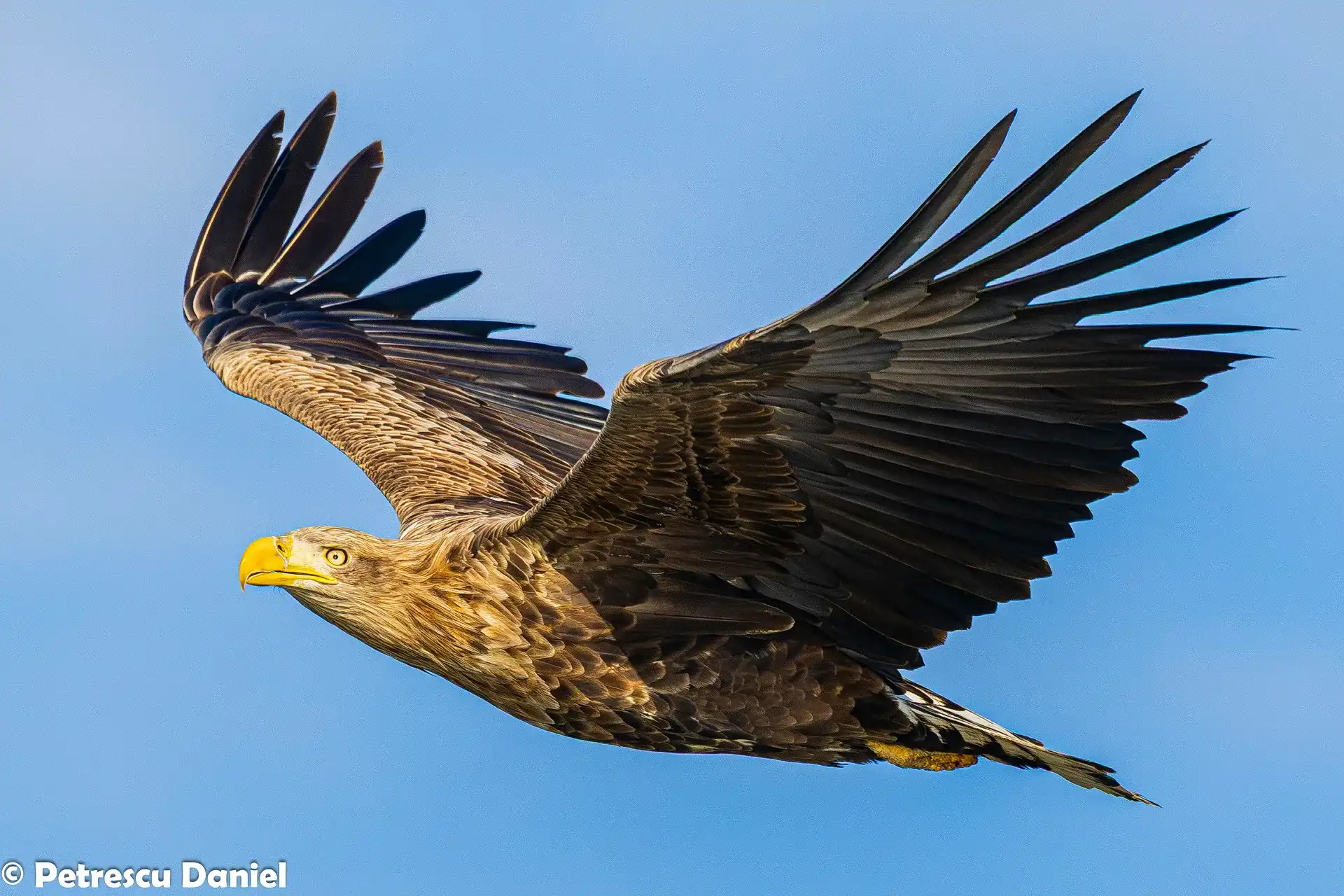
Adults are unmistakable: a very large, broad-winged raptor with a short white wedge-shaped tail and a massive pale yellow bill. The 'flying plank' silhouette — enormous flat wings, short tail — is unlike any other eagle. Immatures are heavily streaked dark brown and take five years to reach full adult plumage.
Field Marks at a Glance
Confusion species: Osprey (Pandion haliaetus) can look similar at distance but is much smaller with distinctive white underparts and angled wings. Lesser Spotted Eagle (Aquila pomarina) is much smaller with a different silhouette.
When to See It in Romania
The White-tailed Eagle is resident year-round in the delta. Breeding activity peaks February–May. Post-breeding numbers increase in autumn as northern European birds move south. Winter brings the highest total numbers — large aggregations form near productive fishing areas.
Monthly Presence & Abundance
Where to See It
White-tailed Eagles hold territories across the entire delta, with the highest density in the Sireasa–Sontea core zone and around the large open lakes. Resident pairs occupy the same territories year after year — experienced guides know exact perch trees and flight routes.
Sontea–Sireasa
Highest density in the delta. Several resident pairs. Eagles hunt coots and ducks on open water at dawn.
Lac Nebunu
Eagles perch on dead trees around the margin, waiting for prey. Best at dawn when most active.
Letea Forest
Nesting habitat — large old oaks provide nest sites. Adults soar over the forest canopy in warm afternoon air.
Sulina arm
Territorial birds often visible from the floating hotel as it moves between anchorages.
How to See It on Our Tours
All Ibis Tours programmes depart from Tulcea and operate within ARBDD-permitted zones.
4-Day Danube Delta Wildlife Cruise
📅 All days — canal channels and lake marginsWhite-tailed Eagles are resident and visible on almost every cruise day. Perched in mature willows along the main channels and circling over lakes — sighting rates exceed 95% on all delta tours. The 4-day cruise typically logs 6–12 individual sightings.
View tour details → More Sightings5-Day Extended Cruise
📅 All days — 5+ days of coverageThe extra days make multiple eagle sightings near-certain. The Letea Forest area on Day 4 regularly produces close perched birds.
View tour details →Behaviour & Ecology
The White-tailed Eagle is an opportunistic predator and scavenger, taking fish, waterbirds, small mammals, and carrion. In the delta, fish-snatching from the water surface is a key technique — the eagle drops from a low perch, extends its talons, and snatches a fish without full immersion (unlike Osprey). Aerial chases of coots and diving ducks are frequent and dramatic to observe. Adults are highly territorial and resident at traditional nest sites — some delta nests have been in use for over 30 years.
🛡 Conservation Status
The White-tailed Eagle recovered dramatically from near-extinction in Western Europe through targeted protection. Currently Least Concern (LC) by IUCN. In the UK, reintroduction programmes have returned the species to Scotland, England, and the Isle of Wight. The delta population benefits from the strict protected zone system managed by ARBDD.
Photography Guide
The White-tailed Eagle is a challenging but rewarding photographic subject in the delta. Patient observation from the stationary motorboat yields the best results.
📸 Photography Tips
- Lens: 500–600mm for perched birds at 30–50m. Shorter (300mm) possible when the eagle hunts close to the boat.
- Hunting sequences: When a resident bird begins scanning from a perch, be ready. The complete attack from launch to water contact is 3–5 seconds — burst mode at 10fps minimum.
- Perch shots: Ask the guide to position for a clean background — golden reeds vs grey sky makes all the difference.
- Timing: Activity peaks in the first 2 hours after dawn. Eagles often return to a perch after a successful catch to eat — wait at the perch site.
- Settings: 1/2500s for flight shots in good light. Push ISO to 3200 in overcast conditions rather than slower shutter speeds.
See It With Expert Guides
White-tailed Eagles are resident in the delta year-round, but spring (April–June) offers the most dramatic behaviour. Ibis Tours guides know exact territories and hunting perches from 30 years of daily observation.