
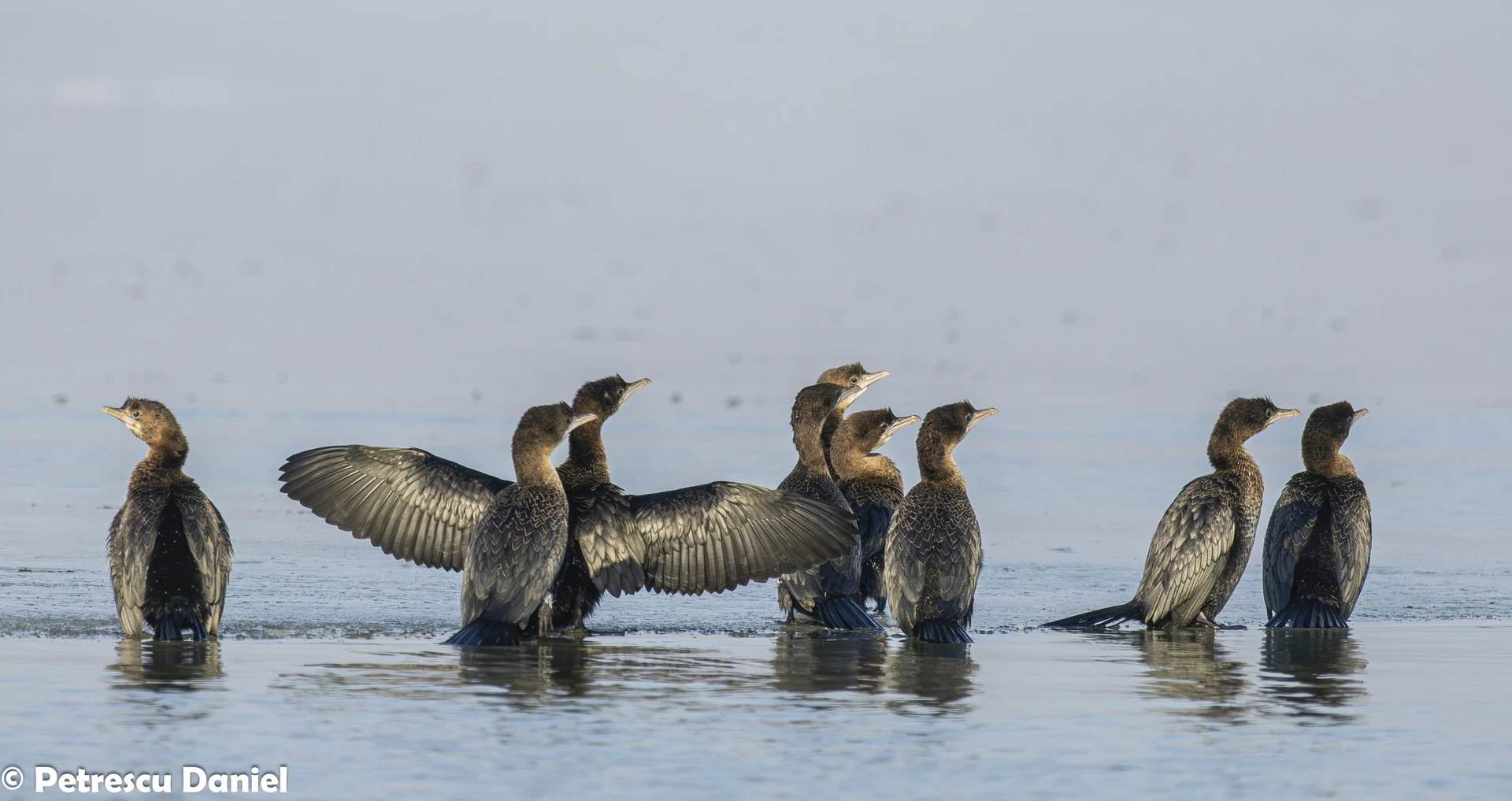
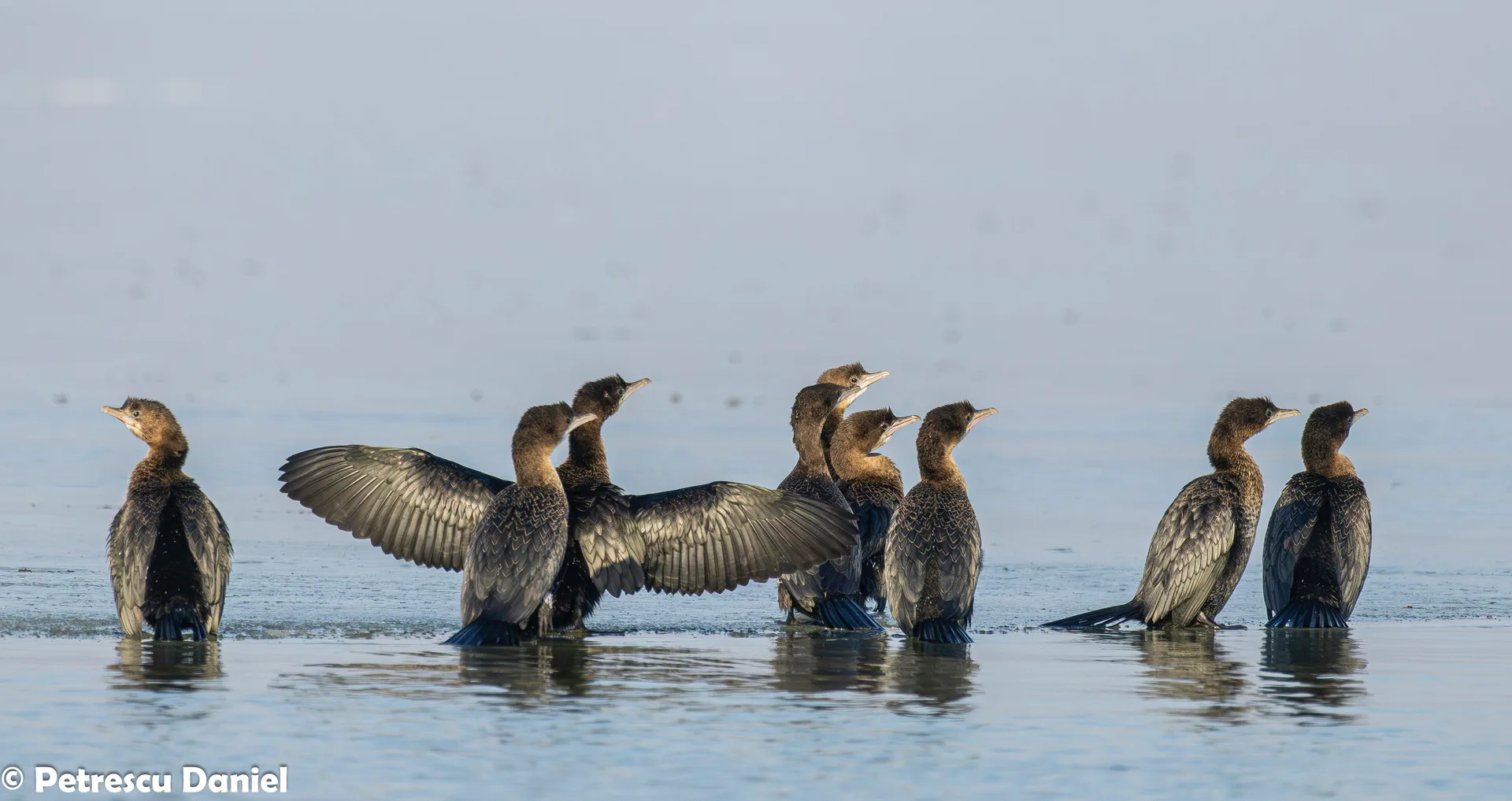
The Pygmy Cormorant (Microcarbo pygmaeus) is a characteristic species of wetlands with reedbeds, narrow channels and shallow lakes. In the Danube Delta it is common, often seen fishing in channels or resting on low shrubs and branches. Identification: smaller than the Great Cormorant; compact brown-black body; short neck and small rounded head; short bill; in breeding plumage the head shows white streaking and a brownish tinge on the neck. Ecology: dives to catch small fish in shallow, vegetated waters. Often perches with wings spread to dry plumage. In the Danube Delta: present in high numbers throughout the warm season; regularly seen alongside herons and egrets on narrow channels. Conservation: the Danube Delta holds one of the most important Pygmy Cormorant populations in the EU; dependent on undisturbed shallow-water habitats with abundant small fish.
Identification
The Pygmy Cormorant is distinctive once seen — small and compact with a short neck and rounded head compared to the larger cormorants. Breeding adults have a warm chestnut-brown head with white flecking; the rest of the body is glossy greenish-black. Non-breeding birds are duller with a pale throat patch.
Field Marks at a Glance
Confusion species: Great Cormorant (Phalacrocorax carbo) occurs in the same habitat but is nearly twice the size with a distinctive white face patch in breeding plumage.
When to See It in Romania
The Pygmy Cormorant is migratory in the delta, arriving in late February–March and departing by October–November. Peak numbers and breeding activity occur April–July. A small number of immature birds may occasionally overwinter in mild years.
Monthly Presence & Abundance
Where to See It
Pygmy Cormorants are found throughout the delta wherever there are narrow channels with overhanging vegetation and shallow water with small fish. They nest colonially with herons and egrets in mixed colonies.
Canal Magearu channels
Dense populations in narrow backchannels. Birds perch at eye-level from the motorboat, often within 5–10 metres.
Mixed heron colonies
Nest alongside Grey Heron, Purple Heron, Night Heron, and Squacco Heron in willows at the water's edge.
Lake margins
Post-breeding congregations on exposed branches around open lakes — roosts of several hundred birds.
All delta channels
Any slow-moving channel with overhanging vegetation will have Pygmy Cormorants. A constant companion throughout all excursions.
How to See It on Our Tours
All Ibis Tours programmes depart from Tulcea and operate within ARBDD-permitted zones.
4-Day Danube Delta Wildlife Cruise
📅 Days 1–3 — willow galleries and lake marginsPygmy Cormorants are encountered daily on all delta cruises — perched in waterside willows, drying wings on dead branches, and in flight along channels. The smaller size becomes apparent when mixed flocks with Great Cormorant pass overhead.
View tour details → All Delta ToursBrowse All Tours
📅 Year-round (peak: breeding season Apr–Jun)All Ibis Tours delta programmes cover the species' main habitats — canal galleries and open lake margins.
View tour details →Behaviour & Ecology
The Pygmy Cormorant pursues small fish — roach, rudd, bleak — in channels too narrow and shallow for larger cormorants. It dives from the surface with a small forward jump, propelling itself with both feet. Like all cormorants it must dry its wings after diving — the characteristic wings-spread pose is seen on any exposed perch throughout the day. Colonial nesting in willows is closely associated with Grey and Purple Heron colonies, providing some protection from aerial predators.
🛡 Conservation Status
Currently Least Concern (LC) but populations are concentrated in very few areas — the Danube Delta system and a handful of Balkan wetlands hold the vast majority of the European population. The species benefits directly from the Danube Delta Biosphere Reserve protection regime.
Photography Guide
The Pygmy Cormorant is an excellent subject precisely because of its habit of perching at eye-level from the motorboat on overhanging branches. The challenge is capturing it in good light with a clean background.
📸 Photography Tips
- Lens: 300–400mm ideal for channel perch shots — birds are often close. 500mm+ for flight shots.
- Position: Low angles work best. Drift into position with engine cut rather than approaching directly.
- Background: Sharp bird against out-of-focus water vs cluttered twigs is a huge difference. Ask the guide to position for clean water backgrounds.
- Wing-spread pose: Predictable behaviour on sunny days after diving — watch for it and pre-compose.
- Light: Overcast light removes harsh shadows in narrow channels. Bright sun can be contrasty in the shaded gârle.
See It With Expert Guides
The narrow backchannels where Pygmy Cormorants are most abundant require the small motorboats operated from the Ibis Tours floating hotel. Day-trip vessels from Tulcea rarely penetrate this deep into the delta.