
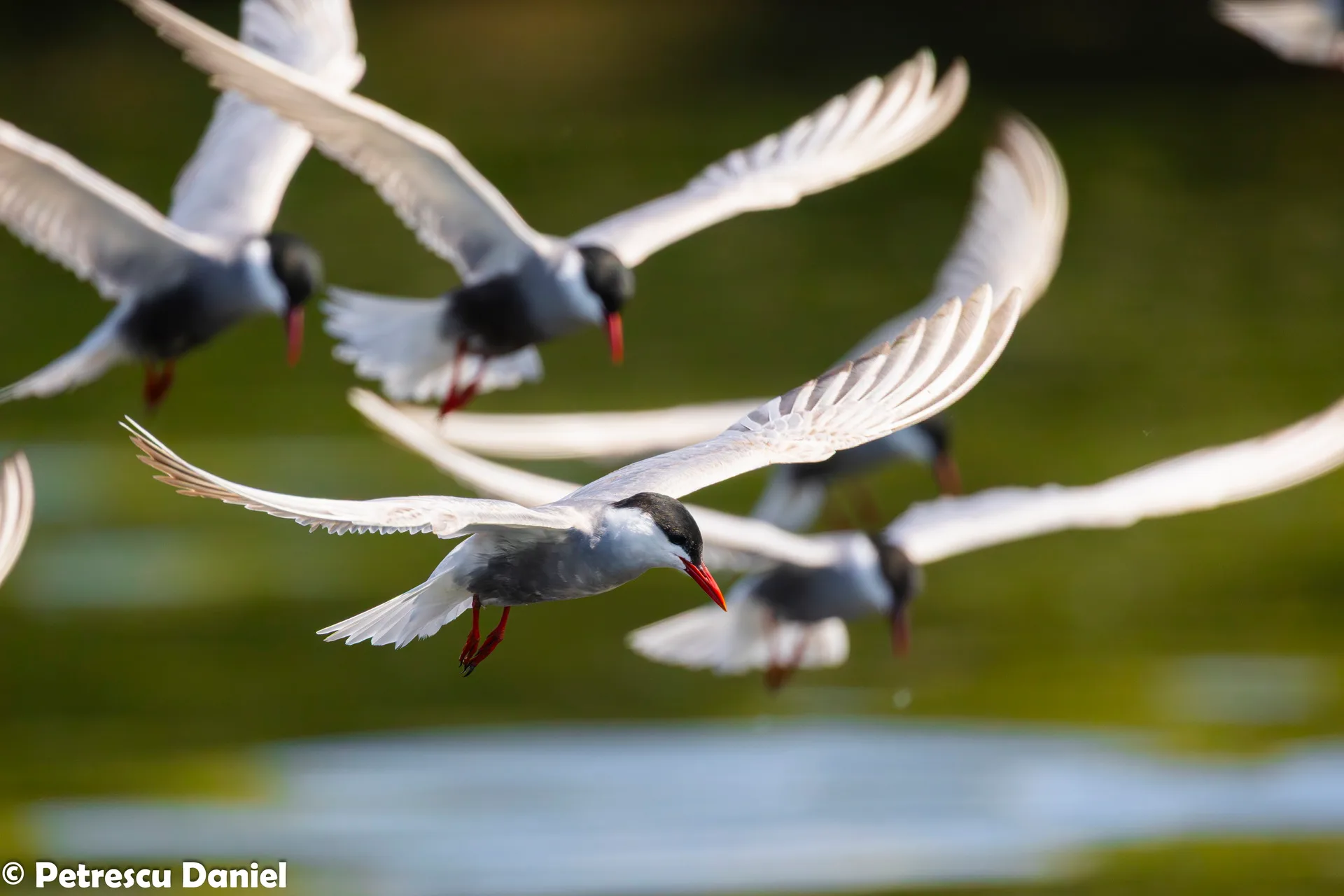
The Whiskered Tern (Chlidonias hybrida) is the most common and most widely distributed marsh tern in Romania, and one of the defining birds of the Danube Delta in summer. Colonies numbering tens to hundreds of pairs breed on floating vegetation across the delta's shallow lakes and marshes from May to August. Identification: in breeding plumage, the black cap contrasts sharply with white cheeks — the 'whiskers' that give the species its English name. The underparts are dark grey, darkest on the belly, while the upperwings and tail are pale grey. The bill and legs are deep red. The largest of the three European marsh terns (Chlidonias), noticeably bulkier than Black Tern and White-winged Tern. Ecology: feeds by dipping to the water surface or hawking insects in flight. Diet includes aquatic and terrestrial insects, crustaceans, amphibians and small fish. Nests are built on floating mats of aquatic vegetation in shallow water. In the Danube Delta: the dominant marsh tern on every summer excursion. Breeding colonies are active from May through July, with post-breeding flocks building through August. Peak numbers occur on the shallow vegetated lakes of the core zone. Conservation: globally Least Concern (LC). Romania holds one of the largest breeding populations in Europe, estimated at 16,000–20,000 pairs. The species is sensitive to wetland drainage, disturbance at colonies, and loss of floating vegetation.
Identification
The Whiskered Tern is the largest and bulkiest of the three European marsh terns. In breeding plumage, the combination of black cap, white cheeks, and dark grey underparts is distinctive. Non-breeding and juvenile birds are paler and more similar to other Chlidonias species, but the heavier build, stouter bill, and slightly forked (almost square-cut) tail help separate them.
Field Marks at a Glance
Confusion species: Black Tern (Chlidonias niger) in breeding plumage has a dark head and breast with no white cheeks, and is noticeably smaller and slimmer. White-winged Tern (Chlidonias leucopterus) in breeding plumage has a black body contrasting with white wings — completely different from Whiskered Tern's grey body and white cheeks. In non-breeding plumage, all three Chlidonias are similar — Whiskered Tern is always the largest, with a heavier bill and slightly forked (almost square-cut) tail.

When to See It in Romania
Whiskered Terns are summer visitors to Romania, arriving from sub-Saharan Africa and the Middle East from mid-April. Breeding plumage is at its peak in May–June. Colonies are active through July, with post-breeding flocks and dispersal through August–September. Most birds have departed by mid-October.
Monthly Presence & Abundance
Where to See It
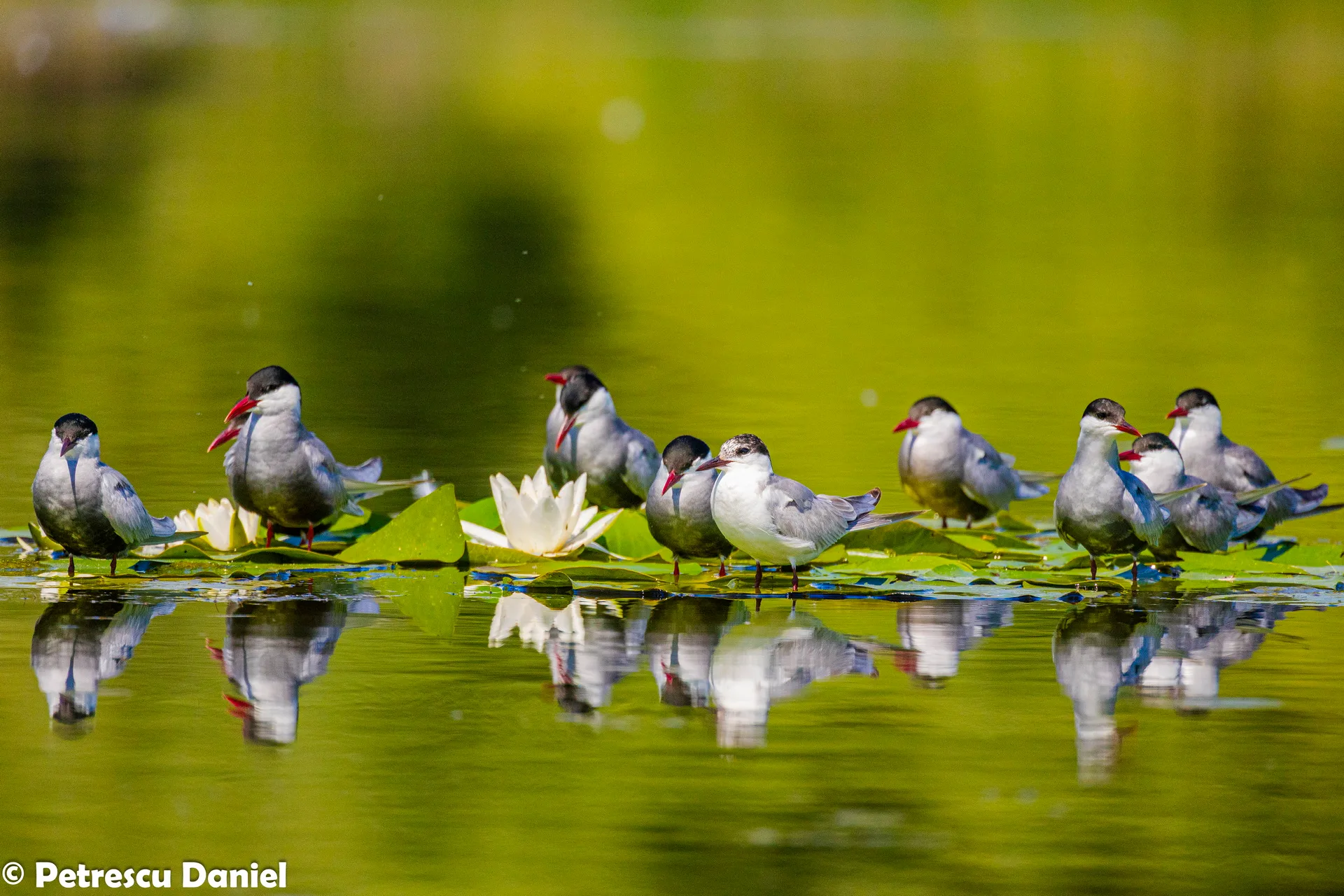
The Whiskered Tern is the most frequently encountered tern in the Danube Delta during summer. It breeds on floating vegetation across the core-zone lakes and marshes, and forages over virtually every waterway in the delta. Outside the delta, it also nests at other wetland sites in the Dobrogea region, along the lower Danube floodplain, and at scattered locations elsewhere in Romania.
Floating vegetation beds — core-zone lakes
The main breeding habitat. Colonies of 10–100 pairs nest on floating mats of aquatic vegetation (especially water soldier, frogbit and dead reeds) in shallow, sheltered areas. Active May–July.
All channels, canals and open marshes
The most frequently encountered tern on every summer boat excursion. Groups of 5–50+ birds forage over the water surface throughout the day.
Lake margins and vegetated shallows
Foraging birds concentrate over shallow vegetated lake margins, dipping and hawking repeatedly above the water surface and reed edges.
Razim–Sinoe lagoon system
Large colonies also breed in the lagoon complex south of the delta, where conditions are suitable. Birds forage over the brackish lagoons and adjacent marshes.

How to See It on Our Tours
All Ibis Tours programmes depart from Tulcea and operate within ARBDD-permitted zones.
4-Day Danube Delta Wildlife Cruise
📅 Days 2–3 — open lakes and channelsWhiskered Terns are the constant companions of every delta excursion from May to August. Breeding colonies on floating vegetation are visible from the boat, and foraging birds dip and hawk insects over the water surface alongside the boat throughout the day. The black cap and white whiskers in breeding plumage are unmistakable.
View tour details → Photography FocusWildlife Photography Tours
📅 May–June breeding seasonPhotography tours time lake crossings for optimal light and tern activity. Whiskered Terns in full breeding plumage against the green delta landscape and blue sky are one of the most reliable and photogenic subjects on every departure.
View tour details →Behaviour & Ecology
The Whiskered Tern feeds by surface-dipping and aerial hawking — patrolling 5–10 m above the water, then dipping to snatch prey from the surface or pursuing insects in flight. Unlike sea terns, it rarely plunge-dives, though it occasionally does so for small fish. Diet is varied: aquatic insects, dragonflies, beetles, crustaceans, amphibians and small fish. Breeding colonies are established on floating vegetation in May, with 2–3 eggs incubated for 18–20 days. Chicks leave the nest within 24 hours and can fly after approximately 23 days. Colonies are aggressively defended — the entire colony will mob predators, including approaching boats. This protective behaviour often attracts other waterbird species (grebes, coots) to nest within the colony perimeter. Etymology: the scientific name hybrida reflects an early misidentification — Pallas (1811) thought the species was a hybrid between White-winged Tern and Common Tern.
🛡 Conservation Status
Currently Least Concern (LC) globally. Romania holds one of the most important European breeding populations, estimated at 16,000–20,000 pairs (SOR/Art. 12 reporting). The European population is estimated at 66,300–108,000 breeding pairs with a generally increasing trend. The Danube Delta's extensive core-zone protection ensures optimal breeding conditions for the species. Principal threats include drainage of shallow wetlands, disturbance at breeding colonies (especially by boat traffic during May–July), loss of floating vegetation through water-level management, and in some European regions, predation by invasive coypu (Myocastor coypus).
Photography Guide
The Whiskered Tern in full breeding plumage — black cap, white whiskers, dark grey body, red bill — is one of the most photogenic birds on every summer delta excursion. The contrast between the black cap and white cheeks photographs beautifully against the green reeds and blue sky.
📸 Photography Tips
- Breeding plumage timing: May–June is optimal — full black cap, vivid white cheeks, deep red bill. By late July some birds begin moulting into non-breeding plumage.
- Colony approach: The observation boat drifts near foraging terns without entering colonies. Terns at 5–20 m are routine when birds forage alongside the boat.
- Lens: 300–500 mm. The birds are often close and fast-moving. A 100–400 mm zoom offers flexibility between portraits and flight shots.
- Flight shots: Track the bird before shooting — Whiskered Terns patrol back and forth in a more predictable pattern than Black Terns. Continuous burst mode at 10+ fps. The surface-dipping moment is the key action to capture.
- Background: Position for clean backgrounds — the white cheeks against dark water or green reeds produce the strongest images. Avoid bright sky backgrounds that flatten the tonal contrast.
- Feeding behaviour: Watch for hovering-and-dipping sequences. The pause before the dip gives a split-second to recompose. Pre-focus on the patrol line.
See It With Expert Guides
Whiskered Tern in full breeding plumage is seen on 95%+ of May–July Ibis Tours cruises. The most common marsh tern in the delta — guaranteed on every summer departure.