
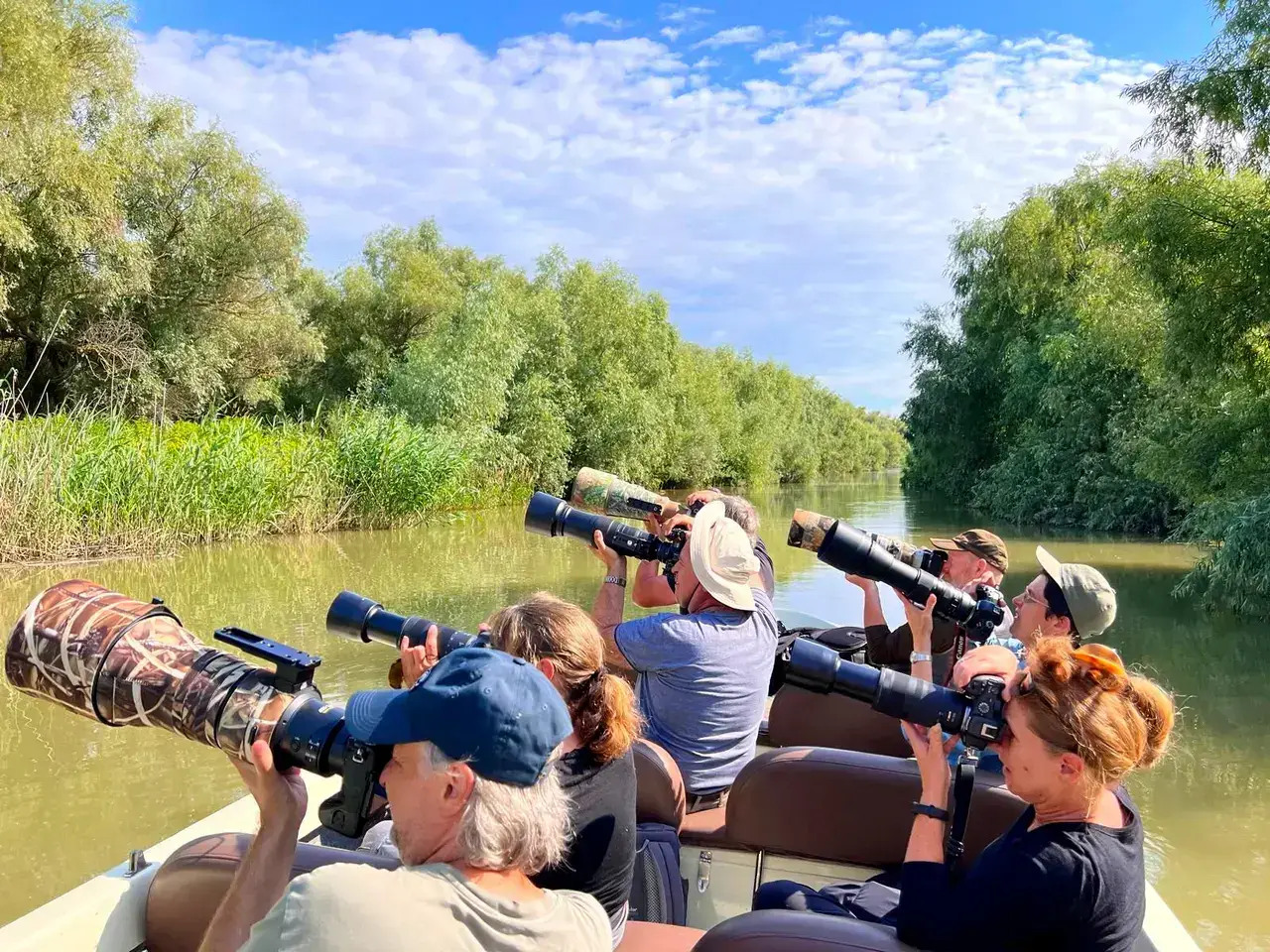
The Danube Delta is one of the most photogenic wildlife destinations in Europe — not because it is easy, but because the combination of extraordinary subjects, close approach distances, and dramatic morning light creates conditions that professional wildlife photographers specifically seek. The floating hotel model means you wake up inside the habitat, ready for the 05:00 motorboat departure that puts you on the water at the moment the pelicans leave their overnight roost.
This guide covers the practical decisions: what gear to bring, how to use it on a moving vessel, how to work the light, and what to expect from each of the key photographic subjects.
Gear: What to Bring
The primary lens question
For most delta subjects, a 100–500mm or 150–600mm zoom is the ideal all-round choice. It covers cooperative pelican fishing groups (300–400mm), close-range Kingfisher perch shots (200mm), and distant raptor flight (500mm+). If you have one zoom in this range, bring it.
A fast prime — 500mm f/4 or 600mm f/5.6 — produces superior image quality for serious photographers who know how to use it. The penalty is weight and the loss of zoom flexibility. On a motorboat where you're adjusting composition constantly, the zoom is often more practical.
A 70–200mm is worth including for environmental shots — wide-angle pelicans against reed beds, portraits showing the habitat context, and the Letea Forest landscape.
Camera body
Modern mirrorless systems (Sony A7RV, Nikon Z9, Canon R5) outperform DSLRs significantly in the delta's conditions: pre-dawn low light, continuous tracking of birds in flight, burst rates of 20–30fps for critical sequences. If you have a choice, the mirrorless body is better here. DSLR users can still produce excellent work — the delta's close approach distances partially compensate for older AF systems.
Support
Forget the tripod. On a moving vessel, a beanbag on the gunwale is the correct tool for resting shots. Pack a medium-density beanbag (500–700g, half-filled with dried lentils or purpose-made beads). It takes up almost no space and makes a decisive difference for supported shots at low ISO.
For handheld work — and most flight and behaviour shots will be handheld — a telephoto monopod is the compromise that some photographers prefer.
Cards, batteries, and weather protection
Bring more than you think you need of both. Three batteries per body minimum — charging points are in the cabin but there's no charging in the field. 128GB+ cards in the fastest format your camera accepts. A rain sleeve for the lens is worth the 50g — morning mist and Sulina arm spray are real factors.
Light: When and How to Use It
The delta's light is exceptional but narrow. Understanding the windows determines whether you come home with portfolio images or merely good record shots.
Dawn (05:00–07:30) is the primary window. Low, warm directional light from the east illuminates subjects that are naturally facing the light — pelicans departing the roost, herons standing on the western bank, eagles scanning from eastern perches. The contrast between the warm sky and the dark reed beds creates the classic 'golden delta' image.
The mid-morning trap (09:00–11:00). Light quality deteriorates rapidly after about 08:30. Overhead sun creates harsh shadows in the narrow channels and blows out the white plumage of pelicans and egrets. Most guides know to use this window for slower cruising and orientation rather than primary photography.
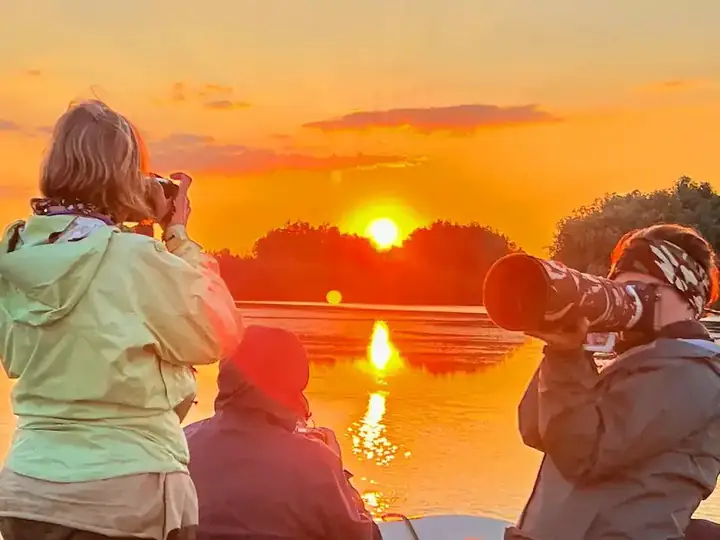
Afternoon (16:00–19:30) recovers quality as the sun moves west. The light angle is now from behind you when facing west-looking subjects — egrets on the western bank, herons in front of reed beds. The last 45 minutes before sunset produces the most dramatic colour in the open lake areas.
Overcast light is underrated for channel photography. Harsh shadows disappear, the Kingfisher's blue plumage glows, and the Pygmy Cormorant's texture becomes readable. Overcast conditions often produce cleaner images in the narrow gârle channels than bright sun.
September advantage. The golden reeds of late September, combined with lower sun angles throughout the day, give photographers a longer useful light window than peak summer. Many professional wildlife photographers specifically choose September for the colour palette.

Shooting from the Motorboat
The Ibis Tours motorboat is a dedicated wildlife observation platform — a small, shallow-draft vessel that can hold position within metres of a subject with engine cut. Learning to use it effectively as a photographic platform is the skill that most separates productive delta photographers from those who come home disappointed.
Engine-cut approach. When the guide spots a significant subject — a perched eagle, a cooperative pelican fishing group, a Kingfisher on a stake — the engine is cut at the appropriate distance and the boat drifts into position. This is the golden window. Do not move suddenly, do not stand up, do not change positions without signalling to other passengers.
Beanbag use. The gunwale on both sides provides a flat resting surface for the beanbag. Use the side that gives the better angle and background — this changes as the boat drifts. A moment's patience for the drift to carry you to the optimal position produces a categorically different background than shooting immediately on arrival.
Low angle discipline. The boat's waterline position gives you a naturally low angle — one of the most desirable perspectives for wildlife photography. Resist the instinct to stand up for a 'better view.' The seated position, with the lens at near-water height, produces the separation from the water background that makes delta images distinctive.
Burst strategy. For behaviour sequences — pelicans plunge-fishing, a Kingfisher leaving a perch, an eagle dropping to the water — pre-focus on the likely launch point, set burst mode (10fps minimum), and begin shooting half a second before you expect the action. The first frame of the sequence is almost always the most important: the moment of maximum energy before blur.
Key Subjects: 12 Species and How to Photograph Them
Dalmatian Pelican. The colony approach (200m minimum, engine off) is best for environmental images showing scale. Cooperative fishing sequences (close approach, drift) are the highest-action opportunity. Shoot at 1/2000s minimum for bill-plunge moments; push ISO to 800–1600 in low dawn light rather than slowing the shutter.
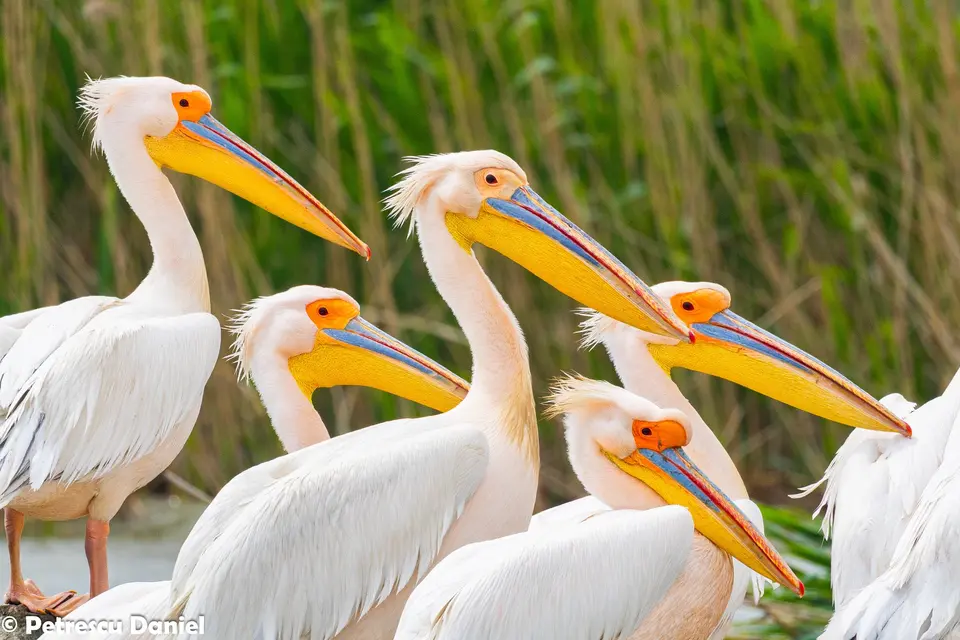
Great White Pelican. The bold black-and-white wing pattern photographs most dramatically in flight against a clear sky. Look for thermal soaring groups in late morning — they wheel overhead and give perfect topside wing-pattern shots. Pouch-flutter in afternoon heat (a cooling behaviour) is an unusual behavioural shot.
White-tailed Eagle. Know the regular perch trees (the guide will position the boat). A clean water background is everything — a dead eagle against a grey sky versus the same bird against blue water is the difference between a record shot and a publishable image. For hunting sequences: pre-focus on the water 10m ahead of the perch, set 20fps, and fire when the bird commits.
Kingfisher. The predictable perch shot is the foundation — find a stake or branch the bird uses regularly, position the boat for a clean background, wait. Departure shots (the blur of blue and orange off the perch) require 1/3000s and continuous AF set to the widest tracking zone. Dawn light hitting the blue back against dark water is the definitive delta Kingfisher image.
Purple Heron. Reed-bed launches give dramatic wing-extension images. The bird is more skulking than Grey Heron — patience at channel bends where they hunt produces the best results. 400mm+ for birds at 20–30m distance in the channels.
Night Heron. Dusk excursions, after other passengers may be less interested, produce the most atmospheric shots — birds in silhouette against an orange sky, or emerging from willows in the last light. Tripod or rested support essential at ISO 3200–6400 in dusk conditions.
European Roller (Letea Forest). The most predictable large photographic subject in the trip — perches on wires and dead branches for extended periods. Vehicle approach works perfectly; shoot from the window with the engine off. The display flight happens repeatedly in May — lock on early, shoot the full sequence.
Pygmy Cormorant. The wing-spread pose (drying after a dive) is the classic shot — predictable on any sunny morning on any exposed branch. Position for a clean water background; the dark bird against bright sky works less well. 300mm is often sufficient for close-range channel perch shots.
Glossy Ibis. Iridescence is the priority — directional morning sun hitting the back and wings from behind you. The 07:00–08:30 window is definitive. Flight shots in this light are spectacular but brief; the birds cross the sky quickly and don't circle like raptors.
Squacco Heron. The transformation from cryptic brown (perched) to white (in flight) is the shot. Pre-focus on a perched bird and wait — when disturbed, the white wing flash is explosive. A moderate shutter (1/1600s) captures the wing positions that show both the flying white and the warm brown back.
Marsh Harrier. Most active at dawn over reed beds. A low-angled reed-bed background emphasises the hunting flight. Males in courtship display (spiralling, food passes) are spectacular in April–May; females on the nest approach deserve respect for distance.
European Bee-eater. Colony sites (sandy banks) give portrait opportunities at normal distances. In flight, Bee-eaters are fast and erratic — pre-focus on the colony entrance point and shoot the departures. Groups in aerial display above the colony give flight images with multiple birds in the frame.

Post-Processing Notes
Delta photography presents consistent post-processing challenges that are worth anticipating:
White pelican exposure. The combination of pure white plumage and dark water background is a high-contrast scene that fools matrix metering. Shoot with +2/3 to +1 stop of positive exposure compensation when the bird fills more than 30% of the frame, or use spot metering on the white plumage.
Highlight recovery. Shoot RAW — the recovery range in compressed files is insufficient for pelican highlight detail. With RAW, pulling back highlights by 80–100 points in Lightroom/Capture One recovers significant detail in white plumage.
Delta colour cast. Morning mist creates a slight blue-green cast in the shadows. A +8 to +15 amber adjustment in the shadows colour wheel warms the image without affecting the white tones.
Motion blur at dawn. If your shutter speed was insufficient for peak sharpness in the dawn light (a common issue), Lightroom AI deblur or Topaz Sharpen AI can rescue moderate motion blur in the subject while retaining background softness.
Photography-Focused Departures
Ibis Tours offers dedicated wildlife photography tour departures where the schedule is adjusted for maximum photographic opportunity: earlier motorboat departures, longer station time at productive sites, and guidance on composition and technique from the naturalist. These departures are limited to 6–8 participants.
All standard 4-day and 5-day cruise departures include substantial photography time — the naturalist guides are accustomed to the pace of serious photographers and position the motorboat accordingly. If photography is your primary objective, mention this when booking and the guide will tailor the excursion schedule.
Photograph the Danube Delta
4-star floating hotel · UNESCO core zone access · Expert naturalist guide · From €1,090 per person full board.