
The Danube Delta cannot be experienced properly from land. There are roads to a handful of villages — Maliuc, Crisan, Sulina, Sfântu Gheorghe — and you can stand at the water's edge at each of them. But the delta's 5,800 km² of channels, reed beds, open lakes, and floating islands exist only by boat. A Danube Delta trip is, at its core, a boat trip.
The question is what kind of boat trip. This guide covers everything: the types of boat-based experiences available, what each offers, how to choose between them, what to expect on the water, which channels are most rewarding, and the practical questions most visitors have before they go.
Types of Danube Delta Boat Trips
There are four main types of boat-based experiences in the Danube Delta, which differ dramatically in what they offer:
1. Day trips from Tulcea port
The most accessible option. Boats depart from Tulcea's river port and travel along the Sulina arm — the main navigable channel — to a destination village (typically Crisan or Maliuc), with a brief stop, then return. Duration: 4–6 hours total. Cost: €15–40 per person on shared boats.
What you'll see: The main Sulina channel is the delta's industrial spine — cargo ships, tourist ferries, and fishing boats share the water. It is wide, busy, and the most developed part of the delta. Birds are present but at distance. Wildlife quality is low. These trips are designed for general tourism, not wildlife observation.
2. Small-boat day excursions from a delta village
Better option. Local boatmen in Crisan, Maliuc, or Sfântu Gheorghe offer 3–6 hour excursions into the channels by small wooden or fibreglass boat. You penetrate further into the delta, see narrow channels, and encounter birds at closer range. Quality varies enormously depending on the guide's ornithological knowledge and which channels are visited.
Cost: €60–150 per boat (negotiable), 1–4 passengers. Access to the UNESCO core zones requires an ARBDD permit and a licensed naturalist guide — not all local boatmen have both.
3. Private charter — 1 to 3 days
A step up. Some operators (including Ibis Tours for smaller groups) offer private motorboat charters with a licensed naturalist guide, departing from Tulcea. You sleep in a delta village guesthouse rather than on the water. Quality depends heavily on the guide.
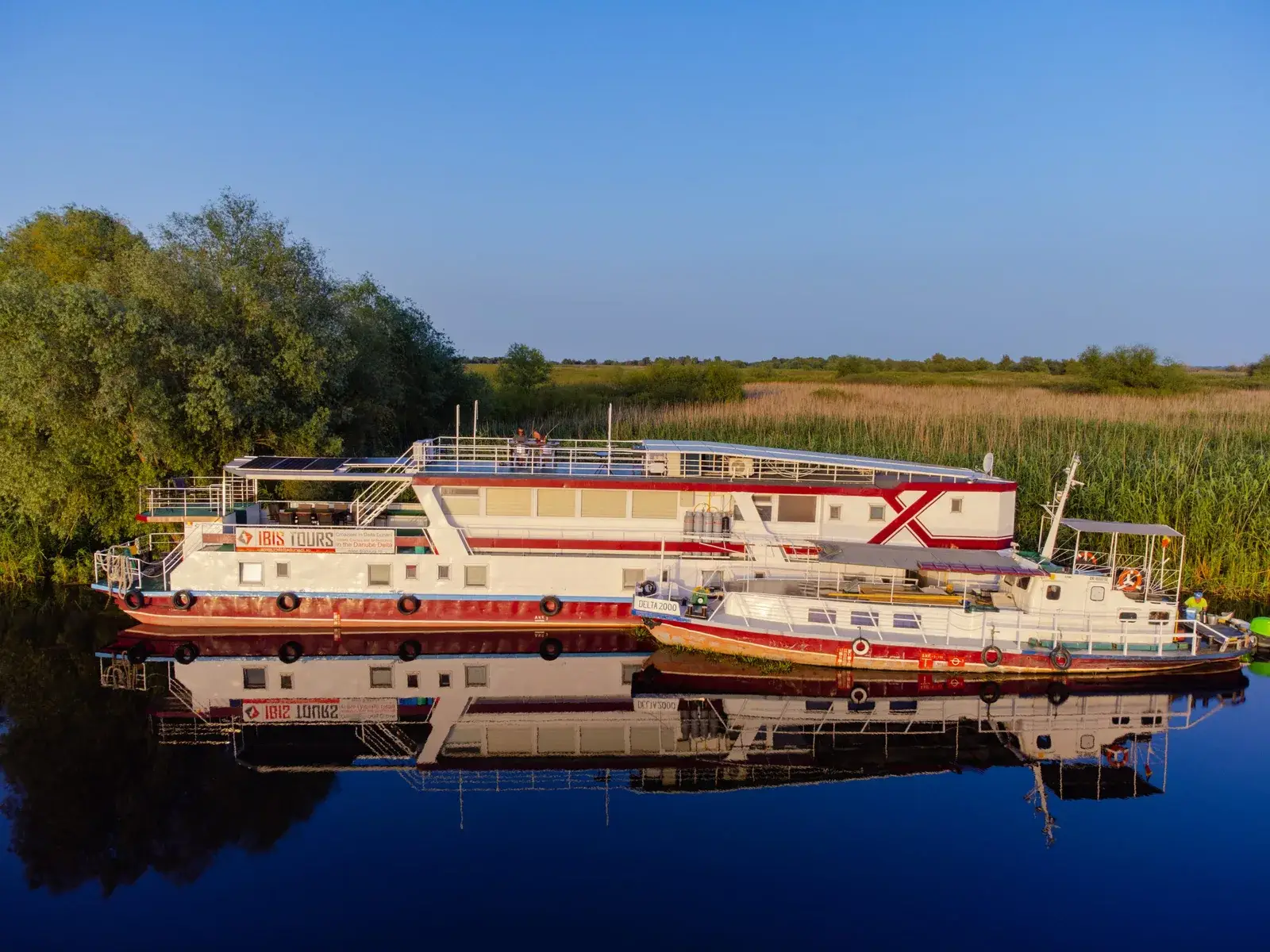
4. Multi-day floating hotel cruise *(the Ibis Tours programme)*
The highest-quality wildlife experience in the delta. A 4-star vessel that you sleep and eat on, with motorboat excursions from it — meaning you can access the remote core zones at dawn and dusk, areas and times impossible from any other base. All meals, permits, and guide services included. 4 or 5 days. See our full guide: [What is live-aboard birdwatching?](/floating-hotel-birdwatching-guide)
The Honest Comparison: Day Trip vs Multi-Day Cruise
The most common question: *is a day trip enough?*
A day trip from Tulcea gives you approximately 4 hours on the main Sulina channel and possibly a brief detour into a secondary channel. In May, you will see pelicans, herons, and egrets. You will not access the strictly protected core zones. You will not observe dawn or dusk bird activity. You will be back in Tulcea by evening.
This is equivalent to visiting the Serengeti and driving along the main tourist road for four hours. The animals are real, but the experience is a fraction of what the ecosystem offers.
A multi-day cruise — particularly the floating hotel format — gives you:
- Dawn access to the core zones (04:30–07:00) - Dusk access for nocturnal species (Night Heron, Spotted Crake, Bittern) - Core zone authorisation that day trips legally cannot enter during breeding season - Expert guide on call for all 24 hours of each day - Accumulated familiarity — by Day 3, you know the productive channels and the guide has calibrated to your specific interests
The species count difference in May is approximately double: 40–60 species on a day trip vs 100–130 species on a 4-day floating hotel cruise.
| Factor | Day trip (Tulcea) | 4-Day floating hotel cruise |
|---|---|---|
| Duration on water | 4–6 hours total | 30+ hours of excursion time |
| Dawn access | No | Every day — 05:00 departure |
| Core zone access | No (day trip permit) | Yes (overnight permit) |
| Nocturnal species | No | Yes — dusk excursions |
| Species count (May) | 40–60 | 100–130 |
| Guide expertise | Variable | Specialist naturalist, ARBDD-certified |
| Cost per person | €15–150 | €1,090–1,200 (all inclusive) |

The Most Rewarding Channels and Areas
The delta is divided into zones with different access rules. These are the areas that produce the best wildlife encounters:
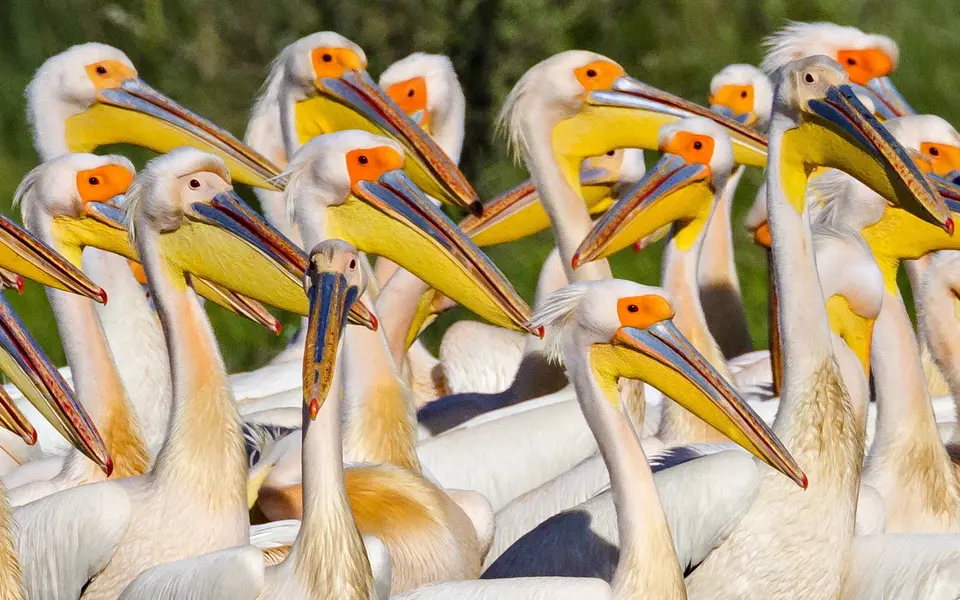
Sireasa — Sontea — Lac Nebunu (western delta core) The most productive area in the delta for waterbirds. Open lakes with Dalmatian and Great White Pelican in their hundreds, multiple White-tailed Eagle territories, and Ferruginous Duck on the floating islands. Strictly protected core zone — accessible only with ARBDD permit and licensed guide. This is the primary destination of the Ibis Tours morning excursions.
Canal Magearu (central delta) The most photogenic channel in the delta — kilometres of floating islands (plauri) draped in water lilies, with Purple Heron and Black Tern nesting on lily pads, Kingfishers on every stake, and Marsh Harriers quartering the reed beds. The floating hotel anchors near here overnight, giving access at dawn and dusk.
Letea Forest (northern delta) Romania's oldest nature reserve, on sand dunes between the northern channels. A sub-Mediterranean oak forest completely unexpected in a wetland — home to European Roller, Bee-eater, Hoopoe, Golden Oriole, and wild horses. Accessible by boat to Periprava, then on foot through the forest.
Sulina mouth — Musura Bay (Black Sea) Where the Danube meets the Black Sea. Tern and gull concentrations, Mediterranean Gull, Caspian Tern, and on lucky days, cetaceans offshore. Accessed on the 5-Day cruise programme.
Sfântu Gheorghe arm (southern delta) A quieter arm with excellent habitat and fewer visitors. Visited on the 5-Day programme. The fishing village of Sfântu Gheorghe is also one of the most atmospheric places in the entire delta — worth an hour on foot.
What to Expect on the Motorboat
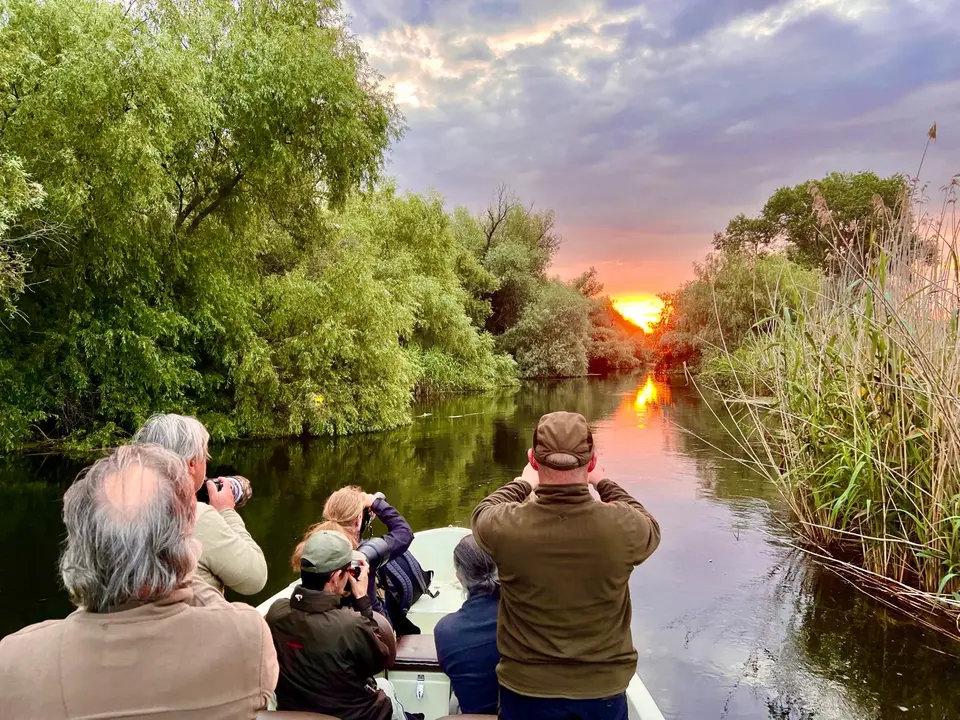
The small motorboat used for excursions from the floating hotel holds a maximum of 10 passengers plus guide and driver. It is an open fibreglass or aluminium vessel, approximately 7–8 metres long, with seating on both sides of the central walkway.
Expect:
- Cold mornings: Even in June, 05:00 on open water is 10–15°C. A fleece and waterproof jacket are essential for every dawn excursion regardless of the season. - Spray: In channels with overhanging vegetation, morning dew from branches creates light spray. A cover for camera equipment is good practice. - Movement: The boat drifts and rocks gently. Binocular use is easy. Spotting scope use is difficult on an unmoored boat — the guide positions the scope on the bank when conditions allow. - Engine cuts: When approaching wildlife, the guide signals the driver to cut the engine. Silence is the key tool for close encounters. The boat drifts — sometimes for 10–15 minutes — while you observe. - No standing: Standing on a moving motorboat is not advisable. The best photography and birding position is seated low, with elbows on the gunwale.

Practical Planning: Getting to Tulcea
All Ibis Tours programmes depart from Tulcea port. Tulcea is the administrative centre of the delta region.
By air: No direct international flights to Tulcea. The nearest international airport is Bucharest Henri Coandă (OTP), served from London Heathrow, Amsterdam, Frankfurt, Vienna, Munich, Paris, Madrid, and most European hubs. Flying time from Western Europe: 2.5–3.5 hours.
Bucharest to Tulcea: - Car transfer: 4 hours (approximately 280 km). Ibis Tours can arrange airport pickup — ask when booking. - Train: Bucharest Gara de Nord to Tulcea — approximately 5 hours. Daily departures. Book via CFR Calatori (Romanian national rail). - Private transfer: Most guests book a private minibus transfer through Ibis Tours or a local transfer company. The most convenient option — pick up directly from the airport and delivered to the port.
Arrival in Tulcea: The Ibis Tours floating hotel is moored at Tulcea port. Embarkation day begins with lunch on board at 13:00. Guests arriving in the morning can leave luggage at the vessel and explore Tulcea (15 minutes on foot to the historic centre).
Frequently Asked Questions
Can I do the Danube Delta in a day trip from Bucharest? Technically yes — a long day (leave Bucharest at 06:00, arrive Tulcea 10:00, 3-hour boat trip, return 19:00). The experience will be minimal and the journey exhausting. Anyone making this journey specifically for the wildlife should stay a minimum of 2 nights in the delta, and 4–5 days for a meaningful experience.
Is the floating hotel suitable for children? Yes, for children aged 7 and above. The boat is stable, the excursions are adapted, and younger guests typically find pelicans, eagles, and horses captivating. The primary consideration is the early morning start (05:00 dawn excursions) — young children who are not morning-people may struggle.
What happens if the weather is bad? The delta operates in all weathers. Rain does not prevent excursions — the guide provides waterproof ponchos if needed, and many wildlife species are more active and visible in overcast conditions. Strong wind can occasionally delay or modify excursion routes, but the guide always finds productive alternatives. A full weather cancellation has not occurred in 30 years of Ibis Tours operations.
Can I join mid-cruise? No — the programme is designed as a continuous experience. The floating hotel anchors in remote areas overnight and there is no practical access point mid-cruise. All guests board on Day 1 in Tulcea.
Is there WiFi on board? No WiFi. Limited mobile signal (Romanian operators) on the main arms; no signal in the core channels. Most guests find this a feature rather than a problem.